

A website that assists guardians with homework help so they can explain concepts to their students outside of school—designed for a 4-day “AI for good” hackathon.
View website
Research Objectives
- Identify existing competitors within the educational AI market and evaluate their strengths and weaknesses.
- Learn about current trends relevant to both educational learning and artificial intelligence (AI).
- Understand the previous experiences and approaches parents and guardians have had with homework help.
- Discover the goals, needs, motivations, and frustrations of parents and guardians whom assist their children with school assignments.
Competitive Analysis
Taking a closer look at the current educational platforms and evaluating what their strengths and weaknesses are provides a deeper understanding of what is working well for users and identifies what could use more ideation.
The competitors focused in this analysis are Grammarly, Symbolab, and Duolingo.
Insights Gathered
After comparing Grammarly, Symbolab, and Duolingo, the following insights stood out the most:
- Over-reliance is a risk to be considered in all platforms and should be avoided to promote learning retention.
- Wide variety of educational subjects is important, so the user does not need to switch platforms per subject (e.g., using Grammarly for English homework then switching to Symbolab for math homework).
- Practice materials and additional resources are crucial elements to a successful learning experience.
Surveying
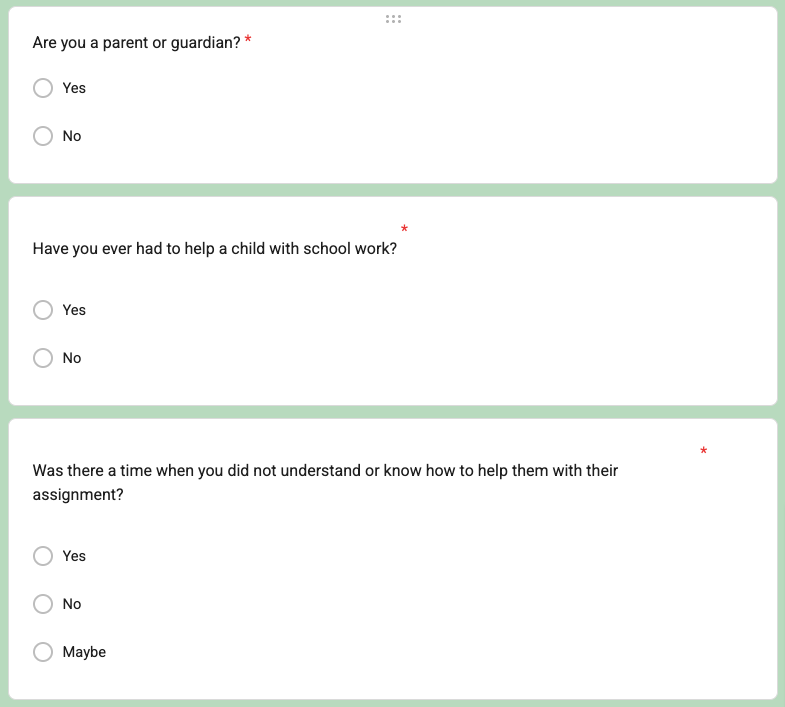
To learn more about the pain points of parents and guardians during tutoring sessions, a screener survey with the following questions got sent out to recruit interview participants.
Discover the problem
What we learned after the interview
After surveying, we conducted 6 user interviews with parents and guardians.
What we learned from the parents and guardians is:
- “I try to incorporate fun into learning so homework feels less like a chore for both of us.”
- “I struggle to teach subjects the same way they’re taught in school—the methods and materials have changed.”
- “Sometimes I have to alter my method when my child learns differently than I did.”

Defining the problem
The Problem
Parents and guardians have difficulty assisting their students with school assignments for various reasons. They need additional educational resources that make tutoring more flexible and engaging.
Situational difficulties to address
- Educational gap—guardians may be unfamiliar with current curriculum (e.g., never completed high school, or curriculum has changed).
- Teaching methods—guardians may have been taught differently from their student’s updated curriculum, causing inconsistency.
Persona
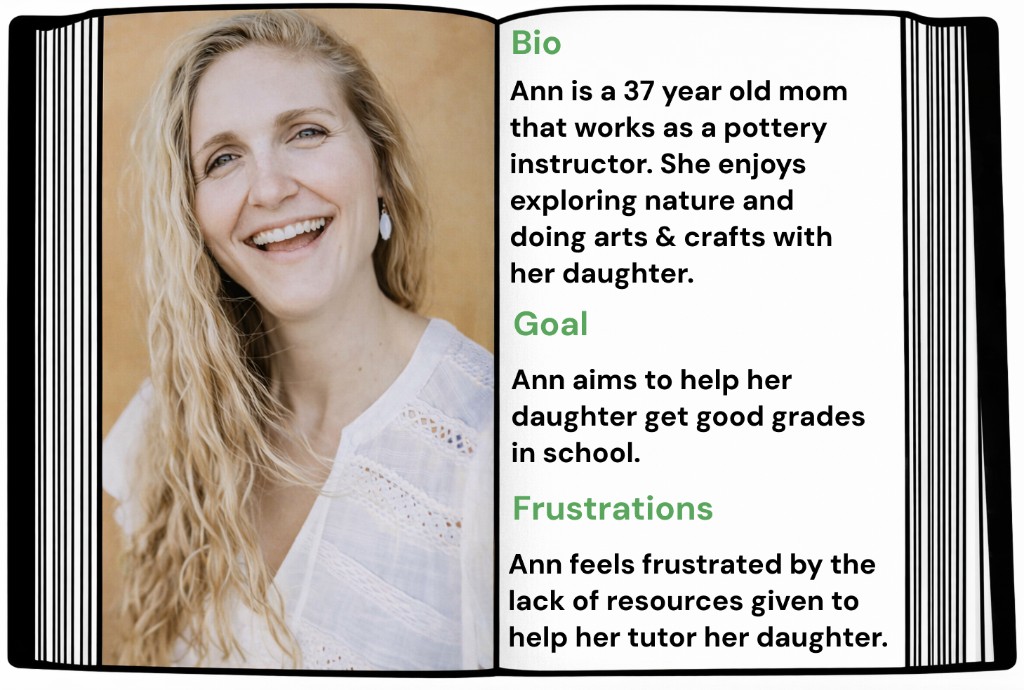
“I wish I had more resources on how to teach my son division using the box method. I never learned that way...”
✏️ How might we use AI to assist parents and guardians that are having difficulty supporting their students with school assignments?
The Solution
We created a website to assist parents and guardians with homework help. Parents and guardians will be able to use Guiding Guardians to ask academic questions to receive step by step guidance followed with similar examples, additional resources, and more explanations as needed.
Designing the solution
Wireframes
User Journey
We designed a flow from home page → user asks the chatbot a question → answer is displayed → options to get another example, simplify the answer, access more information, or get additional resources. The last screen showed generating another example.
Prototype
Testing the solution
Usability Test
After designing the wireframes, 6 rounds of usability testing was conducted to learn more about the functionality of our product. After testing, we used the insights to make appropriate revisions to the product.
Key Insights & Revisions
-
Copy clarity: On the home page, users were confused by “learning over answers.”
A user asked “Does that mean I get the answer first and then learn how to solve it?” We improved the UX copy.Original Revised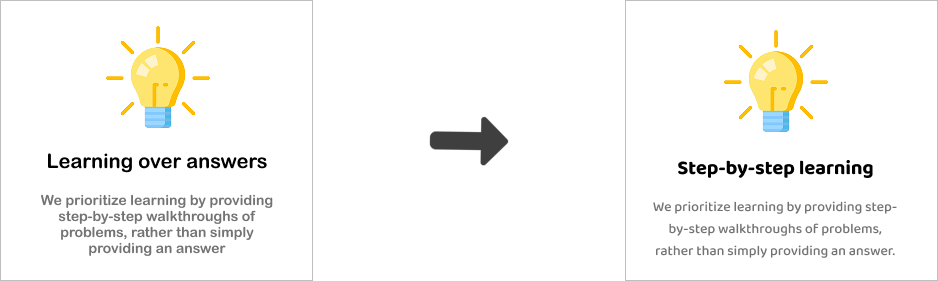
-
Question display: Users were unsure where the question would appear if multiple were asked. We changed the layout so the user’s question and the chatbot’s responses are shown as chat bubbles.Original Revised



-
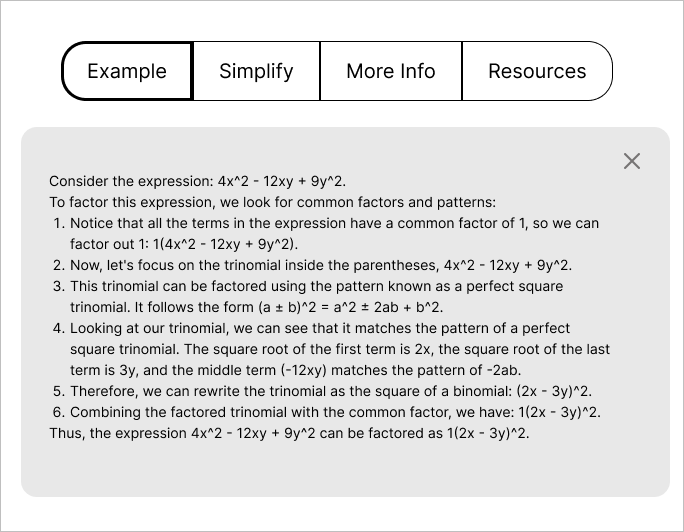
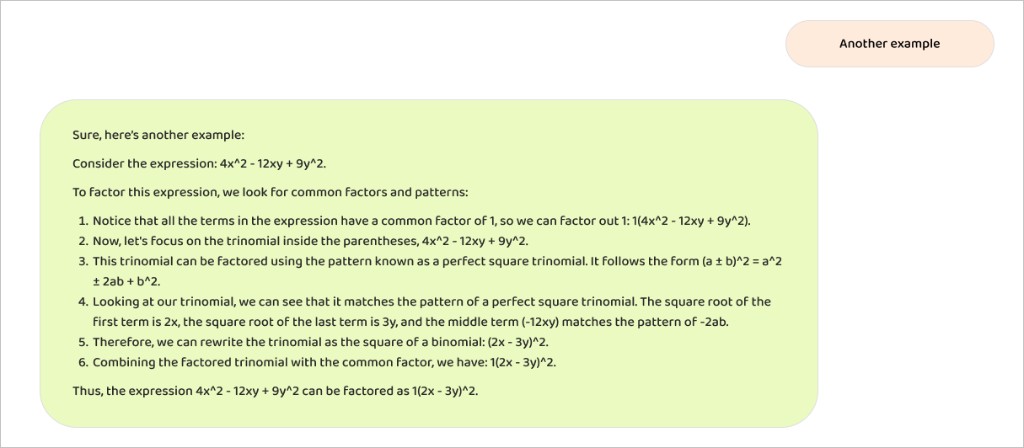
Example format: Users didn’t expect the example to appear as a pop-up instead of following the chat layout. We changed the example to appear as a chat bubble.Original Revised

-
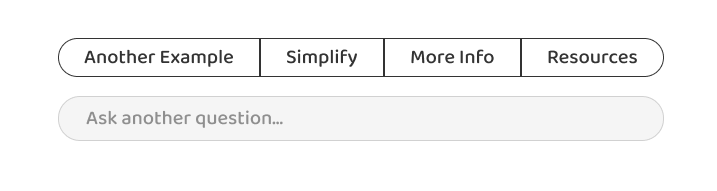
Input affordance: The grey field for typing wasn’t clearly a text box. We added sample prompts to click and text to indicate that users can type another question there.Original Revised


Final Product
Guiding Guardians enables guardians to access a homework-help tool that supports their tutoring approach. We designed to avoid easily giving away answers and to provide multiple resources and follow-up options at each step.
Outcomes
The impact of our design is enabling guardians to access a homework help tool to aid their approach to tutoring school subjects. We did so by designing with the thought in mind to not easily give away answers to homework questions. We also thought of ways to provide multiple resources and answers if the student or guardian faces any difficulty at any of the steps.
Winning crowd favorite was extremely memorable because we got to hear a lot of positive feedback and received validation that we created something useful.
Next steps (given the 4-day constraint): fully responsive product, mobile app version, language translations for guardians with language barriers, filtering by grade level and subject, user profiles, and custom domain.
Key takeaways: Working in a cross-functional team on a short deadline taught me how to collaborate closely with other UX designers and with developers (I joined their live coding sessions to see how everything came together). We had to prioritize for the greatest impact. Winning crowd favorite was memorable—guests who were parents shared that they often use online tutoring help and found the concept useful.