
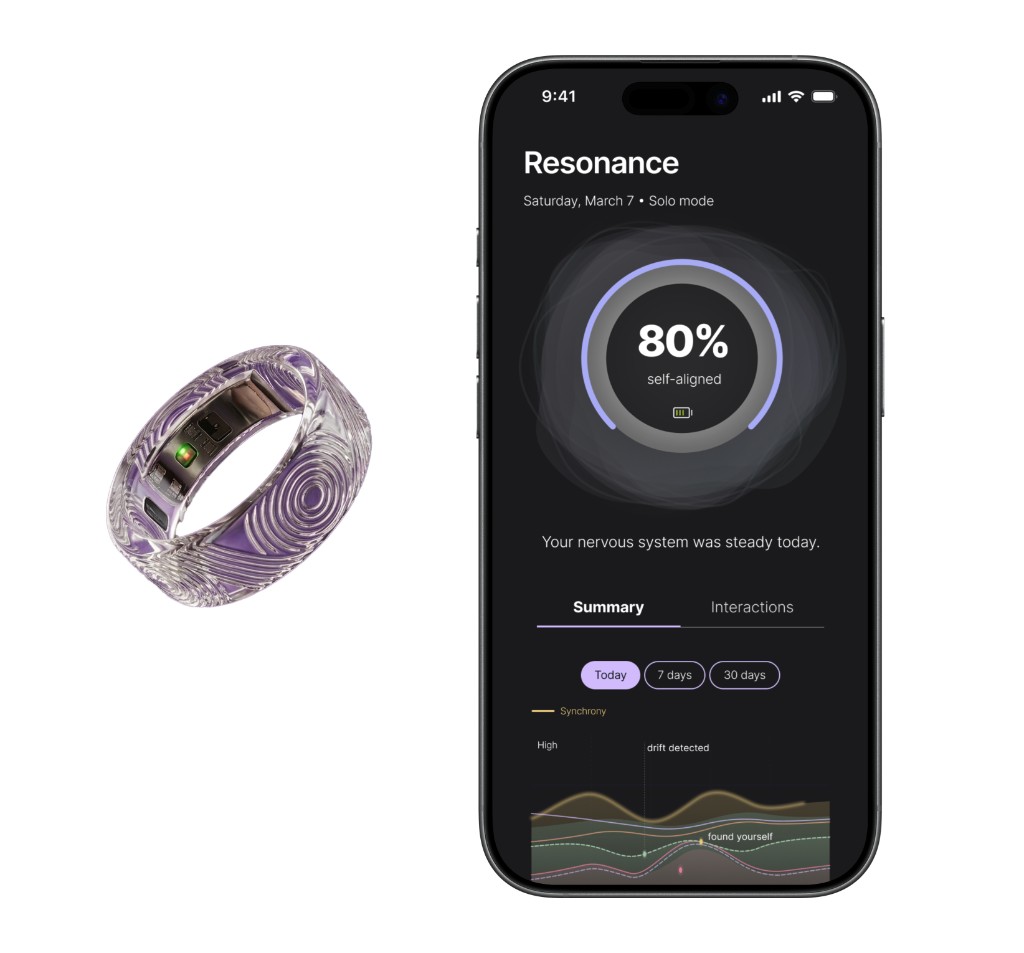
Resonance
Designed a speculative wearable and companion app in a 4-day hackathon that visualizes physiological synchrony to support self-awareness and relational wellness. Executed concept definition, UX design, and prototyping in Figma to translate complex biometric data into intuitive, user-facing insights.
View PrototypeHackathon Requirements
The Challenge
Design a tool that tracks, measures, visualizes or quantifies an aspect of human sensory experience. Within the tool, provide the ability to detect, enhance, or manipulate those same sensory inputs.
Context
The “quantified self” movement has reshaped how we understand our bodies and behaviors, but current tools only begin to capture this potential. Early designers of fitness trackers had to imagine capabilities—like continuous sensing and embedded technology—long before they were technically possible. Following that same spirit of speculation, this challenge asks us to envision the next frontier of self-knowledge by designing for sensory capabilities that do not yet exist.
Our Mission
Identify something intangible, invisible, or previously unmeasurable about the human sensory experience and design a speculative tool to track and influence it. This tool should be designed to support a wellness goal or behavioral change for an individual or a group.
Design Requirements
Your solution should feel novel and future forward, not a remix of an existing app and not something you generate on the first go. This is a speculative design challenge rooted in human need.
Brainstorming
Answering the big question:

“What should we build?”
Idea 1: Social Battery Monitor
Pros
- Helps prevent social burnout
- Feasible implementation
- Addresses a real, relatable problem
- Makes the intangible visible
- Strong visualization concept
Cons
- There’s existing similar products, might be a “remix”
- Oversimplifying relationships
- Needs a stronger “future forward” concept
- Overlap with current existing wellness tools
Idea 2: Sensory Overload Wear
Pros
- Multi-sensory approach
- Immediate, actionable intervention
- Clear and meaningful use case
- Future-forward idea if combined into one product.
Cons
- Overlap with existing products (e.g. noise cancelling headphones) might be a “remix”
- Lacks deeper “invisible sensing”
- Familiar interaction model
- Limited speculative leap
Problem & goals
Describe the problem space and what you set out to achieve.
Process
Walk through your research, ideation, and design process.
Outcomes
Share results, learnings, and impact.